








Tiny Bunny






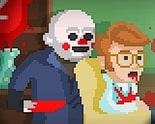



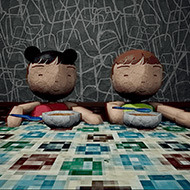
You click on a sandcastle sitting alone on a stretch of grey sand, and nothing happens. You click on the boy standing next to it, and nothing happens either. That stall is the first lesson Tiny Bunny teaches: almost nothing here responds until you’ve earned the response, and the waiting is part of the horror. Tiny Bunny opens on a beach rendered entirely in black and white, seen through the eyes of a boy who has never known color, and the game spends its opening hour making that absence feel less like an art choice and more like a wound.
| Genre | Point-and-click horror-adventure |
| Platform | Browser (HTML5) |
| Setting | A grey-scale childhood beach and school yard |
| Core Mechanic | Dialogue-gated puzzle solving |
A Boy Who Only Sees Grey
The conceit is simple to state and strange to sit inside: everything the boy looks at renders in shades of grey, and the game never explains this with a cutscene. You work it out by trying to describe a red bucket or a blue shirt and watching the boy fumble the color entirely. Rooms that should feel warm read as flat and cold, which is unsettling in a way jump scares rarely manage.
What makes this land is restraint. Tiny Bunny does not surround the boy with monsters chasing him across the sand. Instead it surrounds him with ordinary people behaving slightly wrong and a soundtrack that goes quiet at exactly the wrong moments. The dread is procedural, built out of a mechanic rather than bolted on top of one.
Players expecting a chase-and-hide horror game often bounce off this opening because nothing lunges at the boy. That’s by design: this is a slow, observational horror, closer to an unsettling short story than an attack to survive.
The Bully David and the Missing Walkman
Early in the game you’re pulled into the school yard, where a bully named David corners the boy and demands a Walkman he thinks is owed to him. This scene is the first real test of Tiny Bunny’s dialogue system, because the correct response isn’t obvious and the wrong one sticks with you rather than resetting cleanly. David isn’t a cartoon villain; he’s a kid who has power in this one yard and uses it exactly as pettily as real childhood bullies do.
The Walkman becomes a small quest object that you’ll carry, hide, or hand over depending on choices made a few screens earlier, and the game tracks this without announcing it. Players comparing notes afterward are often surprised their Walkman scene played out differently than a friend’s, since Tiny Bunny rarely flags which earlier click mattered.
By the time you reach the end of the school yard sequence, the boy’s relationship to David has hardened into something specific rather than generic, and that specificity is what people remember days later.
The Sailor Who Won’t Stop Coughing
Down on the beach sits a sailor, hunched over, talking about a book he’s trying to finish while a cough interrupts nearly every line. He becomes the game’s quiet emotional anchor, the one adult in the boy’s grey world who seems to actually see him. Conversations with him unlock slowly across multiple visits; return too early and he repeats himself, return at the right beat and new dialogue opens up.
This is where Tiny Bunny’s pacing asks the most patience of a player. You cannot rush the sailor. You leave, solve something else, and come back, which some players find rewarding and others find like padding disguised as depth. Both reactions show up constantly in discussions of this stretch of the game.
Why Tiny Bunny Won’t Let You Grab the Walkman Yet
The puzzle logic underneath all of this deserves its own explanation, because it trips up nearly everyone. You cannot pick up an object simply because it’s visible and clickable. The boy has to first learn, usually through conversation, that the object matters. Try to grab the Walkman before David’s confrontation makes it relevant, and the boy just looks at it.
This gating is the biggest source of frustration and the biggest source of praise in discussion of Tiny Bunny. Frustration, because a completionist instinct to grab everything immediately gets punished with nothing. Praise, because once you understand the rule, backtracking through the beach and school with fresh dialogue becomes the actual gameplay loop rather than a chore.
New players usually lose an hour circling the same three screens before this clicks, and then Tiny Bunny opens up considerably faster.
The Sandcastle and the Egg in the Hole
One sequence people bring up constantly involves the sandcastle near the sailor’s spot and an egg the boy finds tucked in the sand. Solving it in order matters:
- Talk to the sailor first so the boy understands why the hole beside the sandcastle matters at all.
- Pick up the egg only after that conversation flags it as something the boy would actually want to carry.
- Drag the egg to the hole rather than the sandcastle itself, which is the part most players miss on a first attempt.
- Return to the sailor once the egg is placed, since his next line only unlocks after the hole is filled.
It’s a short sequence but it teaches the full grammar of Tiny Bunny’s puzzles in miniature: notice, understand, act, confirm. Everything later in the game builds on that same four-step rhythm, just stretched across bigger stakes.
Where the Pacing in Tiny Bunny Divides Players
It would be dishonest to pretend everyone loves the slow burn. A recurring complaint is that Tiny Bunny asks you to revisit the same grey screens so many times that the atmosphere wears thin by the fourth or fifth pass. Some players describe these stretches as haunting; others describe the same stretches as repetitive backtracking dressed up in mood lighting.
Both camps agree on one thing: the writing around David, the sailor, and the boy’s home life is stronger than the puzzle design carrying it. That tension between a strong narrative core and pacing that occasionally overstays its welcome is the most honest thing that can be said here.
It helps to treat backtracking less like a fetch quest and more like re-reading a page skimmed too fast the first time, since new dialogue often reframes something seen an hour earlier.
Reading the Yard Before You Act
Players who get furthest fastest tend to share a habit: they examine everything in a scene with a second or third click even after the game seems to have exhausted its response, because Tiny Bunny occasionally changes an object’s available dialogue after an unrelated event elsewhere in the same chapter.
- Re-click background details like the sandcastle after any conversation with the sailor, not just after major story beats.
- Pay attention to which direction the boy is facing before triggering a new conversation, since some lines only fire when he’s looking at the right prop.
- Treat silence or a lack of response as information rather than a dead end; it usually means an earlier step was skipped, not that the game is broken.
Longtime players call this “re-checking,” the closest thing Tiny Bunny has to an advanced technique, since mastery means attention, not reflexes.
Why does Tiny Bunny stay in black and white the whole time?
The grey-scale presentation is tied directly to the boy’s own perception rather than a stylistic filter layered over normal color, which is why the game never briefly flashes color during ordinary scenes. It’s used consistently enough that players treat any deviation from it as a signal something significant is about to happen.
Why won’t the boy pick up an object I can clearly see?
This comes back to the dialogue-gating system described above. If an object won’t respond to a click, the fix is almost always a conversation you haven’t had yet, usually with the sailor or David, rather than a bug or a hidden click zone.
What should I do if the sailor keeps repeating the same line?
Leave the beach, interact with something else in the school yard or the sandcastle area, and come back. The sailor’s dialogue advances on a hidden internal counter tied to other actions, not on repeated attempts to talk to him directly.
Tiny Bunny rewards a kind of attention most browser games actively discourage: slow re-examination, patience with a sailor who won’t hurry his story, and a willingness to sit with a failed Walkman exchange instead of resetting it away. None of that is flashy, and the game seems to know it, letting a grey sandcastle and a buried egg carry more weight than most horror games manage with a full cast of monsters.
Comments
There are no reviews yet. Be the first one to write one.